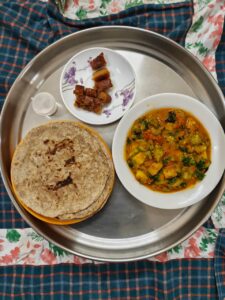
The Softest Green & Gold: Homemade Village Paneer and Pea Mas
In our life in New York City, everything moves at the speed of light. Between the school runs, the constant pings of emails, and the vibrant but noisy streets of Manhattan, finding a moment of true stillness is rare. In this environment, it is so easy to reach for the “convenience” of store-bought varieties of food—pre-packaged snacks and processed cheeses that are often way too salty or full of additives. But some of my most sacred memories are defined not by the speed of the city, but by the slow, rhythmic pace of the villages I have visited around the world. I often think back to a particular morning in a small, dusty village in Northern India.
We were traveling along a winding road when we stopped at a tiny roadside dairy hut. There were no neon signs, just the smell of fresh earth and the sound of cows nearby. I watched as a young man began the process of making cheese from scratch. He didn’t have a factory; he had a large iron pot, a liter of fresh milk, and a few lemons. I realized then that making your own cheese is “way easier than you think” and the result is a soft, cloud-like protein that is far superior to anything wrapped in plastic at a supermarket. In the native language, this fresh cheese is called Paneer, and when paired with vibrant green peas (Matar), it becomes a staple known as Matar Paneer.
In the village, they didn’t use “hard” or overwhelming spices. They relied on the sweetness of the peas and the creaminess of the fresh milk. This was the ultimate “comfort food”. I watched as the village children ate this soft mash with their fingers, their faces lit with energy. It struck me that this was the perfect toddler-approved meal: it is non-spicy, has no refined sugar, and the texture is soft enough for the littlest tummies to enjoy. I brought this lesson home to NYC, where “cooking is always a haven” for me—a way to be creative and nurturing even in the middle of a busy city. This Matar Paneer Mash is our version of a “Shaak” or vegetable gravy, simplified for a toddler’s palate and a busy parent’s schedule.
Key Ingredient Benefits: Goodness in Every Bite
In a remote village, every ingredient is chosen for its “goodness in difficult times”. This dish is a nutritional powerhouse for your growing family.
• Paneer (Fresh Cheese): Making this at home ensures it is soft and free of preservatives. It is an excellent source of Protein and Calcium, which are vital for building strong bones and supporting brain development in toddlers.
• Matar (Green Peas): These little green gems are packed with Fiber and Vitamins A, C, and K. They add a natural sweetness to the dish without needing any sugar.
• Tamatar (Tomato): One soft, ripe tomato provides the base for our mild gravy. It is rich in Lycopene and Vitamin C, which help keep the family’s immune system strong.
• Khajoor (Dates): We use a single mashed date to cut the acidity of the tomato. This provides a “sweet, non-sugary punch” that makes the dish irresistible to kids.
• Turmeric (Haldi): We use just a tiny pinch. It is known for its anti-inflammatory properties and gives the dish a beautiful golden glow without adding heat.
The Recipe: Village-Style Matar Paneer Mash
This recipe is designed with easy words and direct instructions so that even a 10-year-old can help. It uses simple ingredients that are easy to find, whether you are in a remote Indian village or a New York apartment.
Preparation time: 15 minutes Cooking time: 20 minutes Serves: 2 adults and 1 toddler
The Ingredients
1. Milk: 1 liter of full-cream milk (to make the paneer).
2. Lemon Juice: 1 tablespoon (to curdle the milk). Alternative: White vinegar.
3. Peas (Matar): 1 cup of fresh or frozen green peas.
4. Tomato (Tamatar): 1 soft tomato, peeled and finely mashed.
5. Date (Khajoor): 1 soft date, pitted and mashed into a paste.
6. Ghee: 1 tablespoon of Ghee or butter.
7. Pinch of Turmeric: For a golden color.
Easy Step-by-Step Instructions
1. Make the Paneer: Pour the milk into a pot and bring it to a boil. As soon as it bubbles, stir in the lemon juice. Watch as the milk separates into white “clouds” and watery liquid.
2. Strain: Pour the mixture through a clean cloth. Squeeze out the extra water. You now have the softest, freshest Paneer! Crumble it into small pieces with your fingers.
3. Cook the Peas: Put the peas in a small pot with a little water. Boil them for 5–8 minutes until they are very soft. Drain the water and mash the peas with a fork so they are easy for a toddler to eat.
4. Make the Mild Gravy: In a pan, melt the ghee on medium heat. Add the mashed tomato, the date paste, and a tiny pinch of turmeric. Cook for 3 minutes until it smells sweet and looks like a soft sauce.
5. Combine: Stir in your mashed peas and your crumbled paneer.
6. The Finish: Add a splash of fresh milk or water to make it a soft, “spoonable” gravy. Let it warm through for 2 minutes. It should look like a beautiful green and gold mash.
Conclusion: A NYC Family Tradition
When I served this in our New York dining room, the reaction was immediate. My husband, who usually craves “stewy slow-cooked things” or “Salisbury Steak with Mushroom Gravy,” was impressed by how satisfying this “simple food” could be. He loved the richness of the homemade paneer, noting it was “utterly tempting and completely satisfying”.
Our toddler didn’t wait for a spoon. He used his little fingers to scoop up the green and gold mash, humming happily with every bite. There was no “struggle” to get him to eat his vegetables or protein. He loved the soft texture and the mild, naturally sweet flavor from the dates and peas. For a family living in the heart of the city, this dish is a delicious reminder that the best meals are often the simplest ones, made with love and fresh ingredients inspired by the wisdom of the village.